
The Central Thesis.
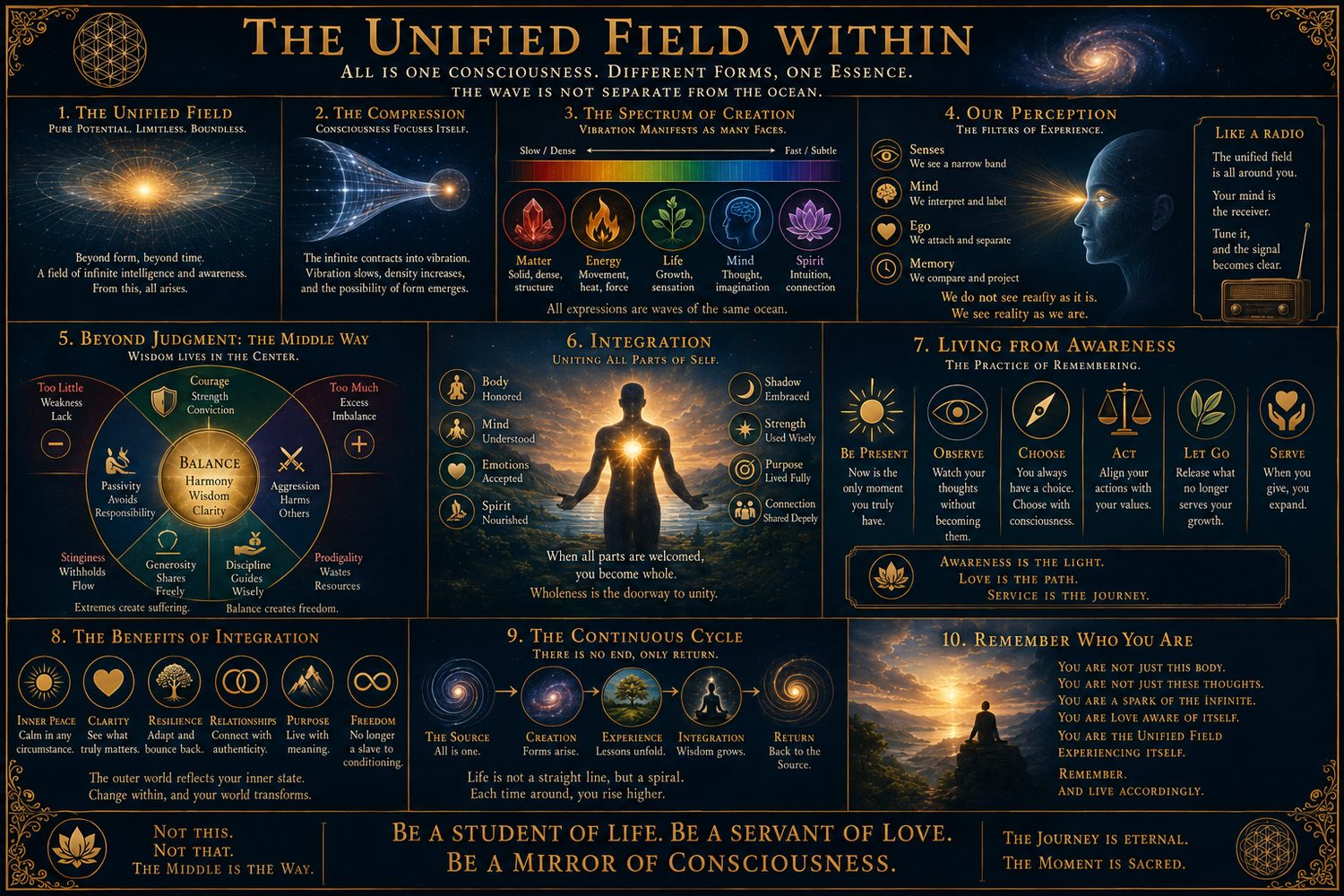
There are four stages through which a consciousness moves: Innocence, Ignorance, Awakening, and Ambivalence. The reason most of us never reach the fourth is not that we lack the will. It is that we were never taught the practice.
This document is the foundational statement of everything I have come to see. It traces the construction of the mask, the imprisonment of the inherited self, the four major transitions through which the ego loosens, and the quiet arrival at Ambivalence, the open hand through which life flows without being grasped.
It is short. Twelve pages. The hardest thing about it was the patience to leave out what did not need to be said. It is meant to be read in one sitting, then revisited as needed.
From the document
Separateness is a concept which lives in your mind. Nowhere else.
The fractal Self, and the game
We exist as a fractal of a higher Self. That smaller, repeating shape is what allows us, as a dense material body, to enter this dense dimension and engage with its reality at all. The body is not a mistake and not a prison; it is the resolution at which the higher Self can touch this world.
We can tap into that higher version of ourselves, but only when we lower the barriers we have built in our own thinking. The barriers are not out in the world. They are in the mind, the same place separateness lives. Reduce them, and the connection that was always there becomes available again.
To understand the dense body, look honestly at what it is built to do. Dig beneath all of our ideas about ourselves and you find one ancient drive underneath: to survive. Self-preservation is the engine. It is why we brace against danger, why we compete, why we can even thrive in chaos and conflict. The organism is made to keep itself going, and, when conditions allow, to reproduce. This is not a flaw or a sin; it is simply the law of the dense world, the same one every living thing obeys.
In this we are not separate from the rest of life. A single-celled organism does exactly what we do, only on a smaller scale: it takes in what it needs, avoids what would end it, and, when there is enough, divides and passes itself on. We are an integral part of nature, not an exception to it. As such we are made to consume, and in consuming to destroy, the way every creature lives by the ending of something else; and when the situation allows we reproduce, handing on not only our cells but the knowledge we have gathered, so that the next generation can begin a little further along than we did. This is the ego at its root, the survival self, and it is not to be despised. It is one half of the pair.
What we cannot do is dissolve the ego, and this is where so much spiritual effort goes wrong. The ego is not an enemy to be killed. It is the part of us that knows how to operate here. To find harmony in this dense existence we do not abolish one side; we balance two: the True Self and the Ego Self, held together rather than at war. This is the meaning carried in the symbol of yin and yang, two opposites that complete each other, each holding a seed of the other.
None of this is possible without awareness. Awareness is what makes balance findable in the first place; without it we cannot see what we are doing, or why. With it, we can step back and watch our own actions as they happen, and ask the honest question underneath each one: am I acting in my own interest, or in another's, out of selfishness or out of care? The watching itself is the practice. It does not force a verdict; it simply ends the sleepwalking, and a self that can see itself can begin to choose.
If there is a purpose to a life at all, perhaps it is this: to come into balance, and through balance into harmony with nature. To grow ambivalent to the craving for any particular outcome, and to let oneself flow with experience rather than fight it. The Taoists called this wu wei, action without forcing, the art of moving with the current instead of against it. It rests on a single recognition: that everything is impermanent and fluid, always becoming something else, and that only the ego ever insists on freezing the river and controlling where it goes.
There is a further turn to this, and it took me a long time to see it. We are each moving along our own timeline, and the timeline we experience is shaped by the perception we hold. As life changes us, our perception changes with it, and we find ourselves sharing a timeline with others whom life has shaped in the same way. Two people can live, for a while, in genuinely different worlds; and when their experience brings them into resonance, they begin to perceive the same reality, each from their own vantage point. Nothing outside forced them together, and neither of them turned a dial. Their inner frequencies simply met, and the shared world followed.
This is why the inner work is the only work that truly changes anything, and nowhere is it clearer than in what I would call addiction, taken in its widest sense. An addiction is any condition in which we keep ourselves habitually occupied with something in order to avoid facing an obstacle, or a wound, that we have not yet been willing to overcome and heal. It can be physiological, a dependence the body has learned to crave. It can be psychological, a pattern of thought or behavior we hide inside. And it can be emotional, the most invisible kind of all, the way we grow attached to our own feelings and to the experiences that stir them, trying to give a permanence to what is passing, to hold the impermanent still because we cannot bear to let it go.
The width reaches further than a habit. An occupation can be a whole system of meaning: a religion, a politics, a cause, a competition, an ideology, a practice of manifestation, a search for the hidden explanation behind events. Any of them can be entered for real reasons and can carry real meaning, and any of them can also be what a person stays busy with so that something else is never met. The more respectable the system, the better the cover it gives.
Whatever its form, the addiction is a way to numb what is underneath rather than turn to meet it. The habit can be broken in more than one way: by building new habits in its place, by stopping all at once, or, most deeply, by training the mind to turn and face the emotional wound that created the craving. But whichever way it goes, no one can do the turning for another person. Others can love us, guide us, and hold the door open; the crossing itself is always ours to make. Only the one carrying the pattern can transform its energy into a healing, and when they do, their frequency changes, and with it the timeline they walk and the world they share.
Trying to escape the ego, or to kill it, only strengthens it. The way through is not war. It is balance.
The struggle against the ego is still attention paid to it, still a self defending a self, and it leaves you further from balance than when you began. When the balance is found, you can move through this reality with a strange and steady freedom: always knowing it is a game, and still choosing to play it. Not fooled by it, and not refusing it. Present, engaged, and unafraid, because you remember what you are underneath the playing.
The Resonance of Timelines
We do not meet reality directly. We meet it through perception, and perception is shaped by what we already believe. Two people can stand in the same room and live in different worlds, because each is reading the moment through a lifetime of assumptions about what is real, what is possible, and who they are. Belief is the lens, and the lens sets what we are able to see.
When we give our attention to an experience, we tune ourselves to its frequency, the way a receiver settles onto a station. And we are never tuning alone. Everyone who has landed on that same frequency is, for a while, sharing a world with us: the same reality, read from a different seat. From the view of the quantum timeline, this tuning is how we synchronize. We are not carried down a single fixed track. We keep landing in the timeline that matches the frequency we are holding, alongside everyone else holding it too. Change the frequency, and the shared world changes with it.
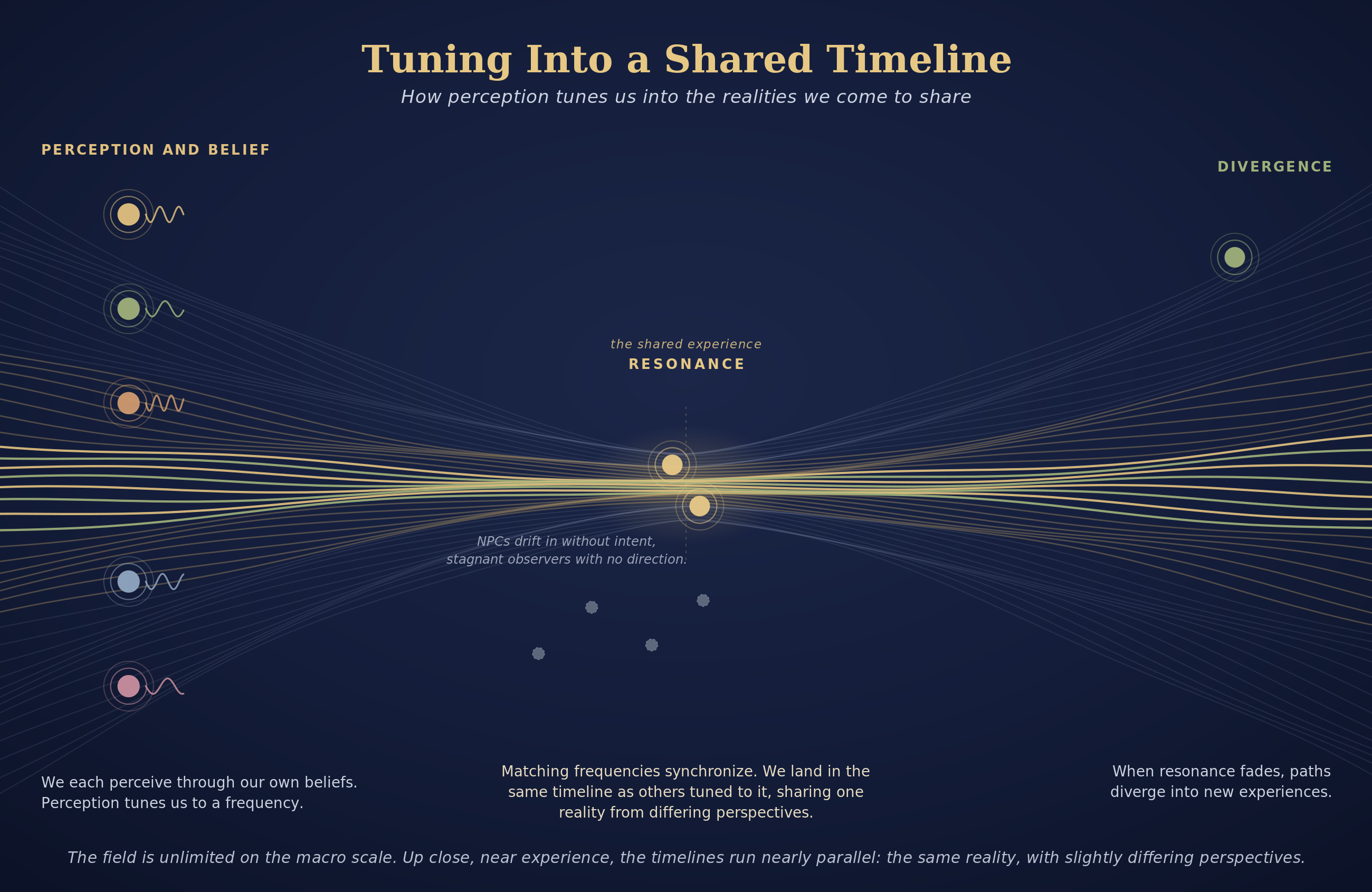
Not everyone is tuning on purpose. What people sometimes call NPCs are not lesser beings. They are stagnant observers, people who have stopped choosing a direction and so fall into whatever timeline the current happens to carry them toward. Their movement is real, but unintentional. Without an aim, they are tuned by their surroundings rather than tuning themselves, and the reality they land in is the one that was handed to them.
This also explains the people who travel together for a stretch of a life. They stay in step not by accident but because they are holding a compatible frequency, close enough to keep sharing experiences while each keeps their own perspective. It lasts exactly as long as the resonance lasts. When one begins to change, to release an attachment or take up a new belief, their frequency shifts, and in time their path diverges from the other and opens onto new experiences. Nothing was broken. The tuning simply moved.
On the largest scale the field is effectively unlimited, a vast branching of every timeline that could be tuned into. But the closer we come to any actual experience, the more the timelines around it converge and run nearly parallel, until the people sharing it are living almost the same reality, separated only by the slight differences of perspective. Far out, endless possibility. Up close, near-agreement. Both are true at once, and which one we feel depends on how near we stand to the moment.
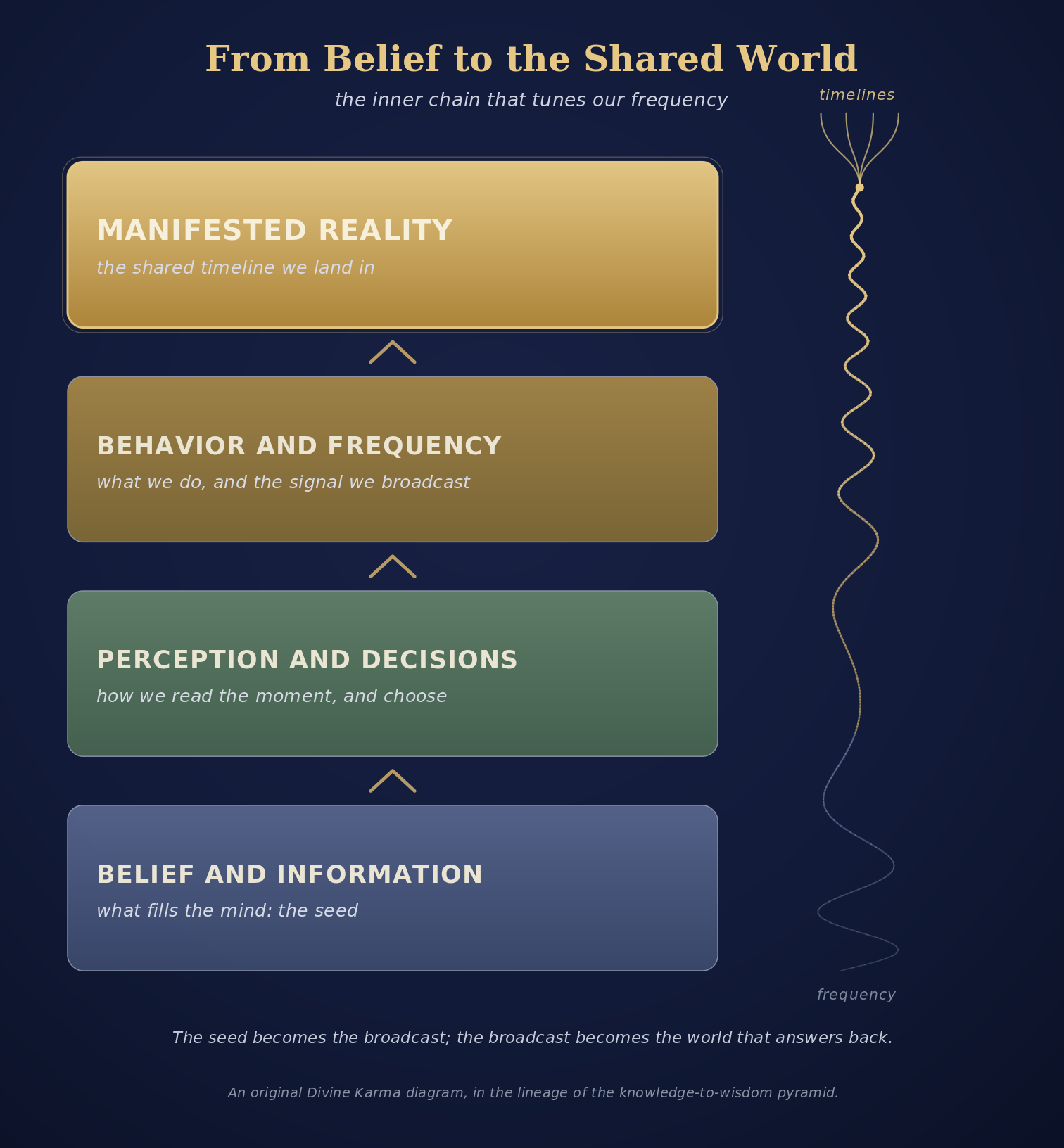
This chimes with a picture Mark Passio has drawn of how our reality is built, in which the quality of the information we take in rises through our decisions and our behavior into the reality we ultimately manifest. What fills the mind is the seed. It sets the frequency we broadcast, and the frequency is what places us in one shared timeline rather than another. So the inner work is never private. To change what fills your mind is to change the frequency you carry, and to change your frequency is to change the timeline you walk and the company you keep on it. We are not trapped on a track laid down for us. We are always, quietly, choosing the station.
What returns, and in whose voice
There is a mechanism underneath the resonance, and it took me longer to name than the resonance itself, because it turns out to be a matter of grammar rather than of physics. What you hold as true leaves you in the first person and returns to you in the second. Nothing is added to it on the way and nothing is refused. The pronoun changes, because the pronoun is the only thing a sentence can change and still be the same sentence.
"I lack" is held, and it comes back as "you lack." It does this for every belief that comes out of your own thinking, without preference and without exception. That is why the return so rarely feels like your own. It arrives in another voice, off the nearest available surface, and the nearest surface is almost always a person. It is also why the evidence is so easy to gather. The colleague really did say it. The pattern really did repeat. What came back was accurate, and accuracy is not the same thing as sympathy.
Two consequences are worth carrying into the rest of this document. A mirror has no memory and no forecast, so a sentence set in the future has nobody standing in front of the glass and nothing returns. That is why "someday" is the most reliable way never to arrive: it is a sentence the mirror cannot answer, and the silence is felt as continued lack. And negation is an operation of language rather than of image. Point at a reflection and say "not this," and the glass shows a person pointing at himself. "I do not want to be poor" returns as attention resting on poverty, because attention is what crossed over and the "not" did not.
Alan Watts walked to the edge of this and called it the Backwards Law: the pursuit of a thing pushes it away, and the search for security is itself the insecurity. He left it as a paradox. It is not a paradox. It is grammar, and it is set out in full at The Pronoun Law.
Beyond Awakening: the canonical distillation
The final spiritual trap is the belief that we must become awakened. The ego abandons ordinary ambition only to seek enlightenment, ascension, mastery, or recognition of its own divinity. It replaces one destination with another and calls the new pursuit transcendence.
The Way begins when we stop demanding that life take us somewhere. Purposelessness is not nihilism, passivity, or the absence of responsibility. It is complete participation without requiring experience to fulfill a cosmic objective. We may create, love, protect, serve, and respond to suffering while recognizing that these purposes arise within life and do not explain why life exists.
Awakening is not reaching a higher level.
It is seeing that the desire for a higher level created the ladder.
Harmony is not permanent peace, but the ability to meet each changing experience without demanding that it be different from what it is. We acknowledge what has arrived, respond according to the moment, and release it when it passes.
Ambivalence is the highest form of consciousness because it allows us to participate fully without becoming attached to a predetermined outcome. It is intimacy without possession, emotion without imprisonment, and decisive action without the demand for control. We do not need to escape the game, master it, or prove that we created it. We play completely, without becoming imprisoned by the character and without claiming superiority over the other players.
The highest realization is not that we are the Creator.
It is that we do not need to know whether we are the Creator
in order to participate completely in creation.
The highest practice is not mastery. It is harmony.
The highest consciousness is not control. It is ambivalence.
So we let go. And then we flow. The complete movement, in one line: Conditioning · Seeking · Seeing the Trap · Letting Go · Participating Fully. We stop looking for the way out and become intimate with the way life is.
The full canonical addendum, Beyond Awakening: From the Search for Meaning to Ambivalence, is available as a standalone reading here.
The spine of the body of work
If anything I have written has ever made sense to you, if Behind the Curtain or any of the series has met you somewhere, this is the spine that holds them together. It is the architecture you may have felt was there.
It is also the entry point to two newer works: The Revolution of the Mind, which expands the thesis into a complete philosophy and metaphysics; and The Way, which distills it into the cadence of the Tao Te Ching for the book to come.
· David