
The Revolution of the Mind.
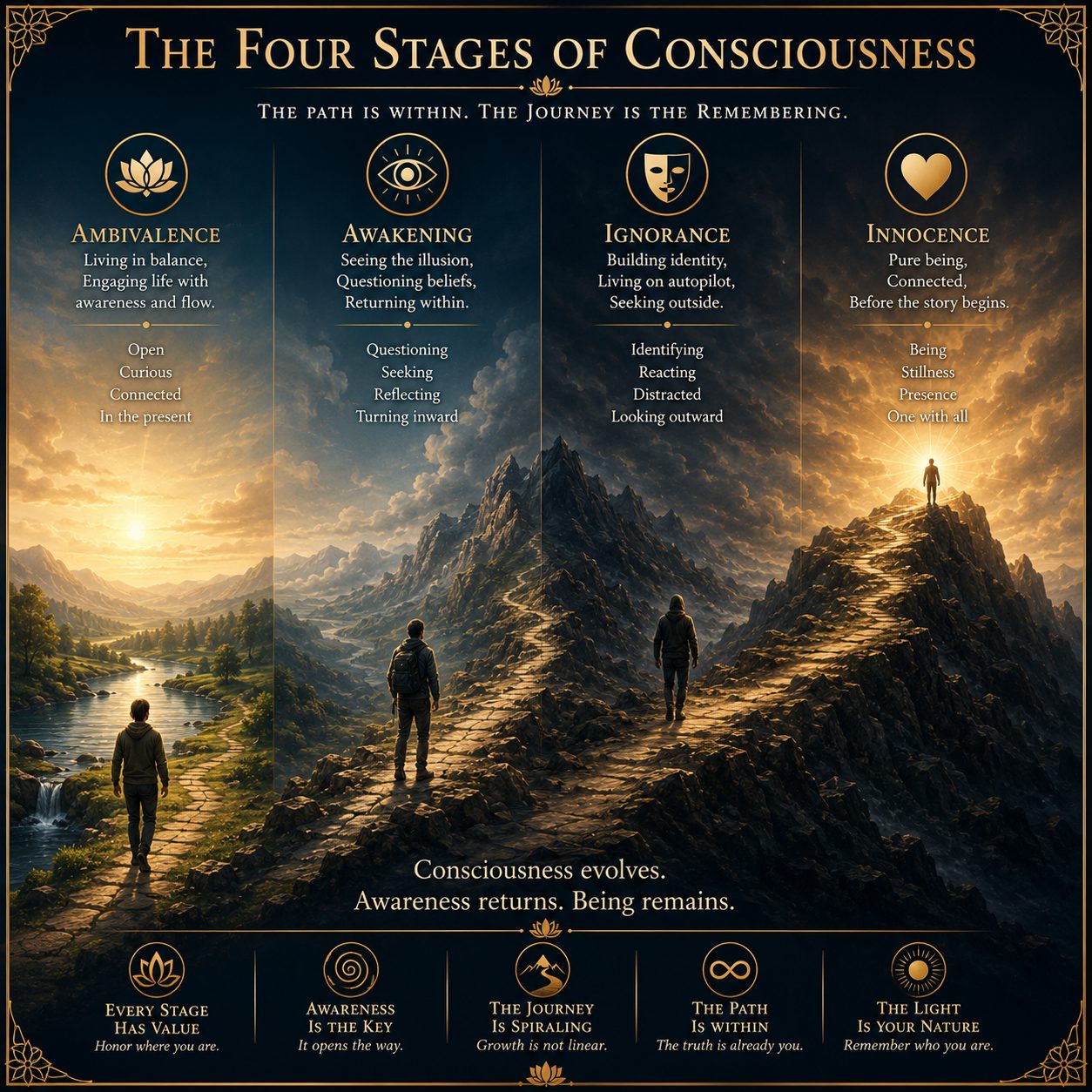
I have been working a discipline for nine years. Every day, or nearly every day, I have written down what I have come to see. The accumulated lines now number nearly two thousand. This is the document where those daily lines are organized into a stated worldview, the most comprehensive piece I have written.
It is offered here as a free PDF. Thirty-nine pages, written to be read in one sitting and returned to in pieces. The button below opens the file.
What the treatise contains
The Revolution of the Mind is divided into two parts.
Part One · The Metaphysics asks what is actually here. The Source. Vibration and form. The observer and the observed. The illusion of separation. Reality as play. A reframing of karma as a pendulum we have been pushing for so long that we have forgotten we were pushing it. And the metaphysics of death.
Part Two · The Philosophy asks how to live within what is here. The egoless origin. The charge. The witness, developed through awareness and through contemplation of self. The practice of letting go. The five apertures the ego cannot fully guard. The Awakening. Compassion as default. Sovereignty and surrender. The way of action without egoic interference. And what this is for.
A line from the book
From section fourteen, on the Awakening:
Enlightenment is like everyday consciousness but two inches above the ground. The two inches are everything.
· D. T. Suzuki, quoted in §14
And the distinction the treatise is built around:
To believe is built on hope. Faith is knowing.
The Final Revolution
A culminating chapter, added August 2026, drawn from the canonical addendum Beyond Awakening.
The Revolution of the Mind is not the replacement of one belief system with another. It is not moving from religion to metaphysics, from God to consciousness, or from salvation to awakening. The final revolution occurs when the mind recognizes its compulsion to turn every insight into another destination.
We no longer need to know with certainty why the universe exists. We do not need to decide whether the Source created us for experience, whether we selected this life, whether reality is a simulation, or whether consciousness is dreaming the physical world. These ideas may remain useful possibilities. But we hold them lightly. We do not allow them to separate us from the experience they attempt to explain.
We stop searching for the hidden mechanism that will permit us to control life. We stop measuring our consciousness against the consciousness of others. We stop treating pain as evidence that we have failed spiritually. We stop converting every experience into a lesson that must advance us toward a higher state. We allow life to be lived before it is explained.
The highest realization is not that we are the Creator.
It is that we do not need to know whether we are the Creator
in order to participate completely in creation.
The highest practice is not mastery. It is harmony.
The highest consciousness is not control. It is ambivalence.
Ambivalence, in the specialized sense used across this body of work, does not mean apathy, indecision, or emotional numbness. It is the ability to remain inwardly free while fully experiencing both sides of life. It is intimacy without possession, emotion without imprisonment, and complete participation without the need to win.
The only purpose we need is to meet the experience presently unfolding, respond to it as clearly as we can, and release it when it passes. There may be nothing to escape. There may be nothing to complete. There may be nowhere else to arrive.
So we let go.
And then we flow.
Read the full addendum: Beyond Awakening: From the Search for Meaning to Ambivalence.
Who it is for
The treatise is written in connected reflective prose. It is not a book of techniques. It is the stated worldview from which the techniques follow. If you have been reading the daily reflections and have wondered where the deeper architecture sits, it sits here.
It is also the philosophical companion to the series. Behind the Curtain opens the question; the Divine Series walks the path; this document explains the territory. The three pieces of writing form one body of work and are best read together over time.
· David