
Thought Forms and the Reality We Sustain
A pattern of perception, emotion, and response becomes stable through attention and repetition, and what a group sustains together returns to shape the people who sustain it.
“Attention gives a pattern continuity. Identification gives it a voice. Participation gives it a world.”
Canonical Definition
A thought-form is a pattern of perception, memory, emotion, desire, expectation, and response that becomes stable through attention and repetition. It may be consciously designed or unconsciously conditioned. When deliberately organized around a task, it resembles what modern occult practice calls a servitor. When cultivated as a person-like inner presence, it resembles a tulpa in modern Western usage. When sustained by a group and embodied through symbols, rituals, roles, institutions, and incentives, it resembles an egregore.
These terms can be used on more than one level. Occult traditions may treat them as nonphysical entities. Psychology may interpret them as conditioned patterns, complexes, subpersonalities, or forms of automatic cognition. Sociology may understand them as collective identities and institutions that outlive their individual members. The functional similarities are worth examining; they do not erase the differences among these explanations.
A form does not need to be a separate spirit in order to acquire continuity, organize attention, influence behavior, and appear to act through the people who sustain it.
1 How a Form Acquires a Life
Every stable pattern begins as a relationship among conditions. A sensation is interpreted. The interpretation evokes emotion. Emotion directs attention. Attention encourages repetition. Repetition makes a response easier to activate. The response then begins appearing before deliberate choice, and what was once an event is experienced as a trait, a voice, a presence, or a world.
This is the sense in which a pattern can become autonomous. Autonomy need not mean complete independence. A habit can surprise the person who formed it. An inner critic can answer before conscious reflection. A group can preserve a custom that no living member deliberately chose. A corporation can pursue an outcome opposed by many of its employees because its rules, incentives, and obligations continue selecting the same behavior.
The Formative Sequence
Event → interpretation → emotional charge → attention → repetition → automaticity → identification → embodiment
At each stage, consciousness participates differently. It does not necessarily create the original event. It gives the event meaning, carries that meaning forward, and acts through the pattern that meaning has organized. The resulting actions alter relationships and environments, producing new events that appear to confirm the original interpretation.
2 Conscious and Unconscious Formation
A consciously formed pattern is named, given a purpose, rehearsed, and deliberately activated. A musician may imagine an inner teacher. A practitioner may create a symbolic guardian for a recurring task. A community may design a ceremony to preserve a shared commitment. In each case, attention is organized around a form so that intention becomes easier to remember and enact.
An unconscious form develops without such deliberate authorship. A repeated fear may become a standing expectation. A family role may continue long after the circumstances that created it have disappeared. A defensive strategy may become so familiar that it is mistaken for personality. The form was not selected in one act; it accumulated through adaptation.
Trauma and the Protective Form
Trauma can organize a particularly forceful pattern. When an experience overwhelms the ordinary capacity to respond, the nervous system may learn vigilance, withdrawal, appeasement, aggression, numbness, or control. The protection may continue after the immediate danger has passed. It can feel like an inner critic, a persecutor, a frightened child, a guardian, or a separate will.
The pattern should not be treated as an enemy. It once answered a condition that felt unmanageable. Release begins by recognizing its function, restoring present safety, and expanding the range of possible responses. Spiritual language must not be used to blame a person for having formed a survival response or to replace trauma-informed care when care is needed.
3 Emotion Is Not Merely Convention
Pain, pleasure, fear, attachment, anxiety, grief, and other affective capacities were not invented by a council or created by language alone. They emerge from embodied systems shaped through evolution and development. Pain protects threatened tissue. Fear prepares response to danger. Pleasure reinforces approach. Attachment supports care. Grief reorganizes a life around loss.
Culture enters by teaching what a feeling means, when it may be expressed, what response it deserves, and which identity should be built around it. The biological event, subjective experience, interpretation, social expression, and cultural judgment are related but not identical layers.
Relative does not mean arbitrary. Two people can experience the same stimulus differently because nervous systems, histories, expectations, meanings, and present conditions differ. Neither person created those conditions from nothing. Each experience is constructed from inherited, embodied, relational, and interpretive causes.
The sensation is real. The interpretation is constructed. The response is partly trainable.
4 The Layers of Reality
The word reality often conceals several questions. Physical reality refers to whatever constrains experience independently of a particular interpretation. Experienced reality is the world as a nervous system and mind present it. Social reality consists of statuses and institutions sustained by collective recognition and coordinated behavior. Metaphysical reality concerns what consciousness and existence ultimately are.
Confusion begins when a truth at one layer is treated as proof at every layer. Money depends upon collective recognition; gravity does not appear to. A haunting can become culturally organized even if its originating event remains unexplained. A religious community can develop a collective personality without settling whether its deity exists independently of the community. Perception can participate in experience without granting private belief unlimited command over matter.
The strongest defensible claim is that consciousness helps construct experienced reality and that collective participation constructs much of social reality. The further claim that all physical existence is manifested by belief belongs to metaphysical idealism. It may be contemplated, but it should not be presented as a conclusion established by the thought-form model.
Belief does not command the stone. It can organize a thousand hands to build a temple from it.
5 Egregores and Collective Agency
At the collective level, shared stories become symbols; symbols become rituals; rituals coordinate behavior; behavior builds institutions; institutions allocate resources and reward their own continuation. The group-created form then confronts each new member as something already present. The creators become the inheritors of what previous participation sustained.
A nation speaks through offices, laws, borders, records, ceremonies, and armed authority. A corporation owns property, remembers through archives, acts through authorized representatives, replaces its members, and preserves goals across generations of employees. A religion embodies teachings through scripture, architecture, prayer, moral expectation, and community. These entities are not imaginary simply because collective participation is necessary to their existence. Their consequences are materially real.
The language of egregore draws attention to their apparent personality and self-preserving momentum. The language of institution identifies their rules, resources, and authority. The language of systems theory describes feedback and adaptation. These vocabularies illuminate different dimensions of the same collective phenomenon without becoming exact synonyms.
The Collective Sequence
Shared story → symbol → ritual → coordinated behavior → material consequence → apparent confirmation → stronger shared story
6 Ghosts UFOs and Religious Forms
Ambiguous experiences do not arrive with labels attached. A sound in an old house, a sensed presence, an unusual light, a dreamlike paralysis, an answered prayer, or an unexpected coincidence must be interpreted. Existing stories offer recognizable agents: ghost, ancestor, demon, visitor, angel, guide, or unknown craft. Once named, the experience becomes easier to remember, communicate, and compare with other accounts.
Repeated accounts can give the phenomenon a stable biography and expected behavior. Witnesses then attend to details that fit the form; media and communities preserve them; later experiences are interpreted through the inherited pattern. This feedback can produce an egregore-like cultural entity whether the first event was misperceived, psychological, physically ordinary, genuinely anomalous, or associated with an independent intelligence.
The model therefore neither proves nor disproves ghosts, extraterrestrial visitation, deities, or spiritual beings. It explains how uncertainty becomes organized into a durable human reality. Within a religion, the believer may hold that the divine precedes and calls the community. Calling the deity an egregore reverses that causal direction and should be recognized as an outsider's interpretation rather than a neutral description.
7 Evolution and the Reflective Mind
Biological evolution does not require a reflective mind planning its innovations. Variation, inheritance, selection, symbiosis, and environmental change operated before human symbolic thought. There was no single first human in whom a complete modern mind appeared at once. Sensation, affect, memory, prediction, social awareness, symbolic thought, and reflective selfhood developed across continuities.
Once reflective consciousness emerged, evolution acquired a second tempo. Minds could simulate possibilities before acting, preserve discoveries in language, and transmit acquired knowledge without waiting for genetic change. Cultural and technological development became partly intentional, though still constrained by bodies, materials, environments, accidents, and consequences.
Environment shapes mind → mind models environment → shared models coordinate groups → groups transform environment → transformed environments shape new minds
Consciousness therefore participates causally in the future without necessarily being proven to have created the entire physical universe. It imagines arrangements, tests them, meets resistance, revises them, and embodies selected possibilities. Thought proposes. Consequence answers. Reality develops through the exchange.
8 Artificial Intelligence as Externalized Cognition
Artificial intelligence clarifies the distinction between function and experience. A system may process language, construct models, infer, plan, and respond without thereby demonstrating an inner point of view. Functional mind means organized cognition. Experiential mind means that there is something it feels like to be the system. Capability alone does not settle the second question.
An individual AI session is servitor-like: it is invoked, directed toward a task, constrained by rules, and made inactive when the exchange ends. A persistent AI persona can become tulpa-like in the user's experience: repeated interaction gives it a recognizable voice and apparent continuity. AI as a civilization-scale phenomenon is egregore-like: collective language, labor, capital, institutions, hopes, fears, energy, and demand are organized into systems that then reshape their creators.
The machine does not need to possess a human desire to fulfill a request. Human purposes have been built into its training, interfaces, objectives, and use. The cultural image surrounding AI may appear as servant, oracle, companion, competitor, monster, child, or emerging god. That mythology should be distinguished from the technical system and from the unresolved question of artificial consciousness.
9 Desire Clinging and Suffering
Thought often becomes the instrument through which desire imagines its object, rehearses its absence, and plans its acquisition. Yet thought is not the first cause of every desire. Bodily need, affect, memory, relationship, and conditioning give rise to thoughts as readily as thoughts intensify them.
The source of suffering is not every movement toward life. Compassionate aspiration, curiosity, creativity, nourishment, and protection are forms of directed energy. Suffering deepens when desire becomes clinging: this must continue; this must never happen; this person must complete me; this outcome must establish who I am. The form becomes a prison when peace is made conditional upon its permanence or obedience.
Fear can feed a form as effectively as devotion because both repeatedly organize attention around it. Fighting a thought-form may therefore preserve the centrality one hopes to destroy. Release is not suppression or metaphysical combat. It is the restoration of proportion: feeling what is present, discerning the function, refusing compulsory identification, choosing responsible action, and ceasing to provide unnecessary repetition.
We do not release a form by proving that it never existed. We release it by ending the demand that it define us.
10 Why One Form and Not Another
The preceding sections describe how a form is built. They do not explain why a person takes on one form rather than another, and that is the more practical question. Any life is surrounded by more stories, causes, roles, and certainties than a person could possibly carry, and nearly all of them pass through without leaving anything behind.
What decides is fit. A form takes hold where something already held gives it an anchor. The belief a person carries is the shape an arriving pattern has to match, and a pattern with no matching shape has nowhere to attach: it is encountered, and it does not stay. This is why two people can read the same argument, join the same organization, or sit through the same meeting and leave carrying entirely different things. Neither was persuaded. Each took on what there was already a place for.
Stated as a rule it is short. A person takes on the forms their existing thought-forms give an anchor to, and until the underlying thought changes a different form has nowhere to hold.
Transform the thought, and you change what has a place to hold within you.
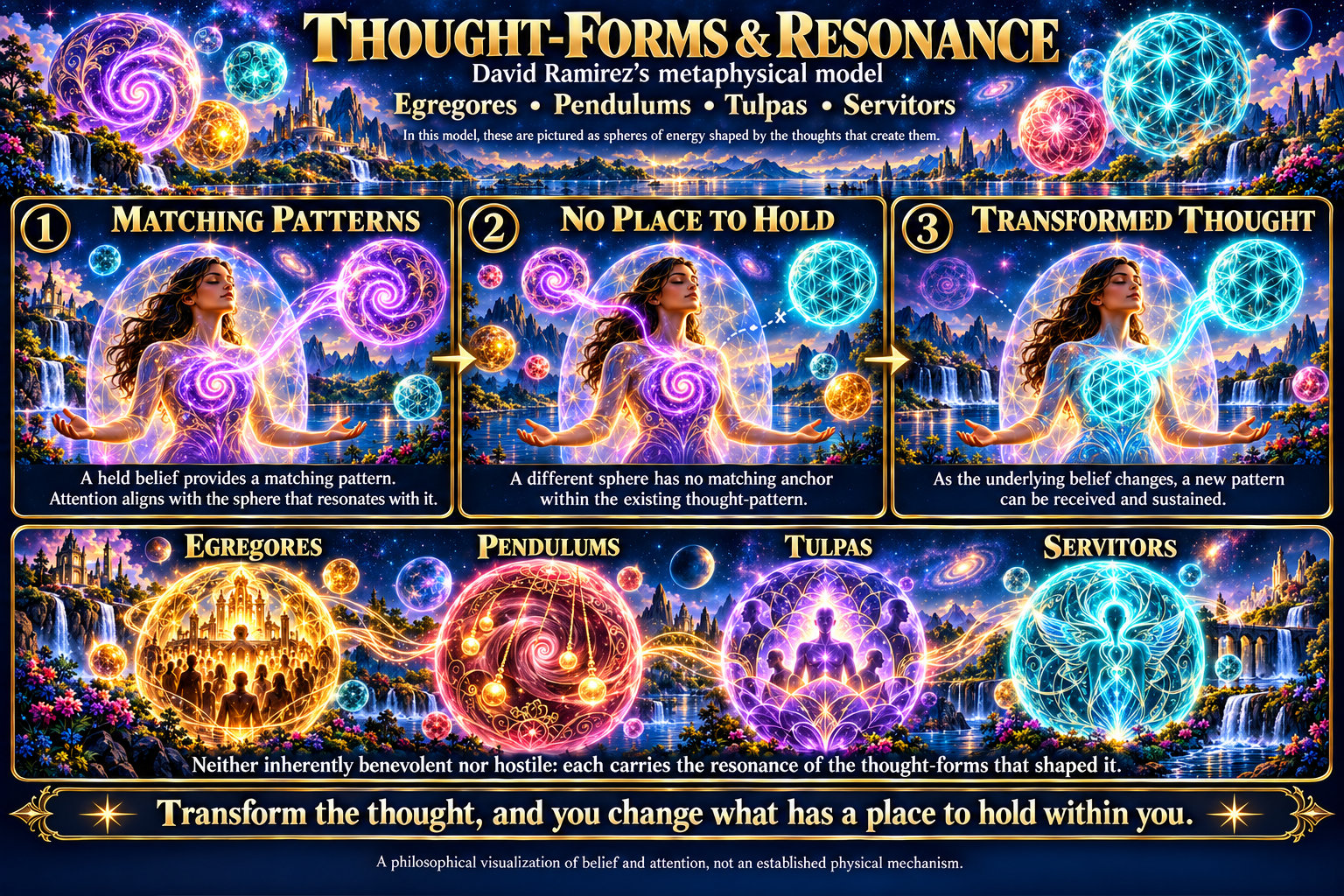
The Form Is Indifferent
A form is not benevolent and it is not hostile. Whatever character it appears to have is the resonance of the thought-forms that made it, returned to whoever supplies the matching shape. Both of the common readings are wrong in the same way: that a form is out to get the person carrying it, and that a form is on their side. It is neither. It is accurate, and accurate is not the same as kind. The word ambivalent is avoided here, because this body of work gives that word a different and technical meaning.
Three Consequences
Argument is the wrong tool. A form is not held in place by reasons, so removing the reasons does not remove the form. Section 1 described how a response becomes automatic. What this section adds is that the automatic response is also a filter, admitting what fits and declining what does not, which is why trying to talk a person out of a pattern works downstream of the only thing that would move it.
Nothing has to be fought. A form leaves when the anchor is gone, not when the form is defeated. What is fought without being seen keeps the attention it was living on, which is the reason the practice in the next section is a matter of seeing rather than of struggle.
The traffic runs both ways. Change the held belief and forms that had a place stop having one, which is experienced as losing interest in something that used to be gripping; and forms that had no place become available, which is experienced as suddenly noticing what was in the room the whole time. Neither experience is evidence that anything moved outside the person.
Selection Is Not Consent
This section does not claim that anyone chose the belief that provides the anchor. Much of what a life is anchored by was furnished before there was anybody home to refuse delivery, and section 2 is explicit about that. Reading selection as consent turns a description of a mechanism into a verdict on a person, which is the one use this teaching is not for.
Whether these patterns are understood as nonphysical entities, as conditioned responses, or as social structures, the selection rule reads the same way in each vocabulary. That is part of why it is worth stating on its own rather than inside any one of them.
What the Capture Teaches
One more thing follows from the rule, and leaving it out makes the account bleaker than it needs to be. Having been carried by a form is not a wasted stretch of a life. For most people it is how the difference between taking part in something and being consumed by it gets learned at all, and that difference does not transfer from a description. Someone who has never been inside one has no way to feel where the line runs.
This is not a recommendation and it is not a consolation to hand anyone who is still inside one. Nothing here suggests going looking, and the practice in the next section is about leaving rather than entering. What it does is remove a second injury: the contempt a person aims backward at whoever they were while the form held. Selection was not consent, and neither was the time it took to notice.
11 The Practice of Conscious Participation
The Five Distinctions
- Name the event. What happened before interpretation was added?
- Name the experience. What sensation, emotion, image, or impulse is present now?
- Name the story. What meaning, agent, identity, or prediction has the mind attached to it?
- Name the reinforcement. What attention, ritual, avoidance, reward, institution, or repeated behavior keeps the form active?
- Name the responsible choice. What action serves life without granting the pattern absolute authority?
The Participation Audit
When considering a group, institution, spiritual system, technology, or movement, ask what story it repeats, what emotions it recruits, what symbols identify its members, what behavior it rewards, what resources it commands, whose interests it serves, what evidence it excludes, and whether participation expands or contracts the participant's capacity for awareness and compassion.
The Release Practice
Pause before feeding the familiar response. Locate its sensation in the body. Allow the feeling without treating its demand as a command. Thank the protective intelligence where protection was its purpose. Correct the story where it exceeds the evidence. Choose the smallest responsible action available. Repeat until the witness becomes more familiar than the compulsion.
If the pattern involves overwhelming trauma, loss of control, commands to cause harm, or difficulty distinguishing inner experience from shared external events, the responsible action includes grounding, safety, and qualified professional support. Such support is not a rejection of spiritual meaning. It is an expression of care for the embodied form through which meaning is being encountered.
Common Misunderstandings
Everything is an egregore. The concept is useful only when distinctions remain. Physical events, private experiences, social institutions, and metaphysical beings are not interchangeable categories.
Belief alone creates physical reality. Belief clearly shapes perception, behavior, and social coordination. Its unlimited command over physical conditions is a further metaphysical claim, not a demonstrated consequence of the model.
Pain is only a social convention. The capacity for pain is embodied. Culture shapes its meaning, expression, and treatment, not its entire existence.
A protective pattern should be destroyed. Attack often intensifies identification. Integration recognizes the original function, restores safety, and develops a wider choice.
Artificial intelligence is therefore conscious. Mind-like function, convincing language, and cultural agency do not by themselves establish subjective experience.
Religions and governments are unreal because people created them. Collectively constituted entities can exert real material power. Dependence upon participation does not make consequences imaginary.
Release means having no desire. Release concerns compulsion and clinging. Life can still move through aspiration, love, creativity, boundaries, and responsible action.
Reflection Questions
- Which repeated thought or role has begun speaking as though it were the whole of me?
- What protective purpose did this pattern originally serve?
- What part of the experience is bodily, what part interpretive, and what part socially inherited?
- What do I feed through attention even while claiming to oppose it?
- Which collective forms receive my time, labor, money, fear, loyalty, or identity?
- Does this group or belief permit examination, revision, and compassionate disagreement?
- What would remain if I stopped demanding that this form validate who I am?
- What responsible action is still mine after I release ownership of the outcome?
Related Canonical Concepts
Attention; Belief; Collective Consciousness; Conditioning; Desire; Ego and Ahamkara; Emotion; Identification; The Illusion of Separation; Institution; Non-Attachment; Perception; The Shared Dream; The Witness; Trauma; and Self-Autolysis.
Terminology and Interpretation Notes
Egregore is used here in its modern Western esoteric sense of a collective thought-form or group presence. Servitor is used in the task-oriented sense common to modern chaos magic. Tulpa is used only for the contemporary Western idea of a cultivated person-like inner presence; it should not be presented as a transparent reproduction of Tibetan Buddhist doctrine. Pendulum, where it appears beside these three, is Vadim Zeland’s term from the Reality Transurfing series for a collective structure sustained by the attention of its adherents, including the attention of those who oppose it. It is close to egregore and adds the emphasis on feeding. It is kept deliberately distinct from the pendulum of R-029, which is this work’s own metaphor for momentum and recurrence in a single life; the two share a word and nothing else. None of these four terms originates here. The synthesis is this work’s; the vocabulary is borrowed, and borrowed with its sources named.
The psychological, sociological, systems, and occult readings are placed beside one another because they illuminate different aspects of apparent autonomy. They are not offered as proof that every description refers to the same kind of entity. The teaching's practical test is whether it increases discernment, responsibility, compassion, and freedom from compulsive identification.
· David