
The limits of perspective.
The perspective that convinces
We experience life through a particular body, a collection of memories, and a perspective shaped by everything we have encountered. The experience is immediate and it is convincing. We know our thoughts, feel our emotions and carry our history, and nothing about any of that is in question here. It is understandable that we come to regard this individual identity as the whole of who we are.
What this essay questions is not the experience but one inference drawn from it. The boundary is real as experience. Whether it is also a boundary of what we are is a separate claim, and it is the one being examined.
So the question is narrow. What if this is the perspective through which something larger is being experienced, rather than the whole of what is being experienced?
Character, player, creator
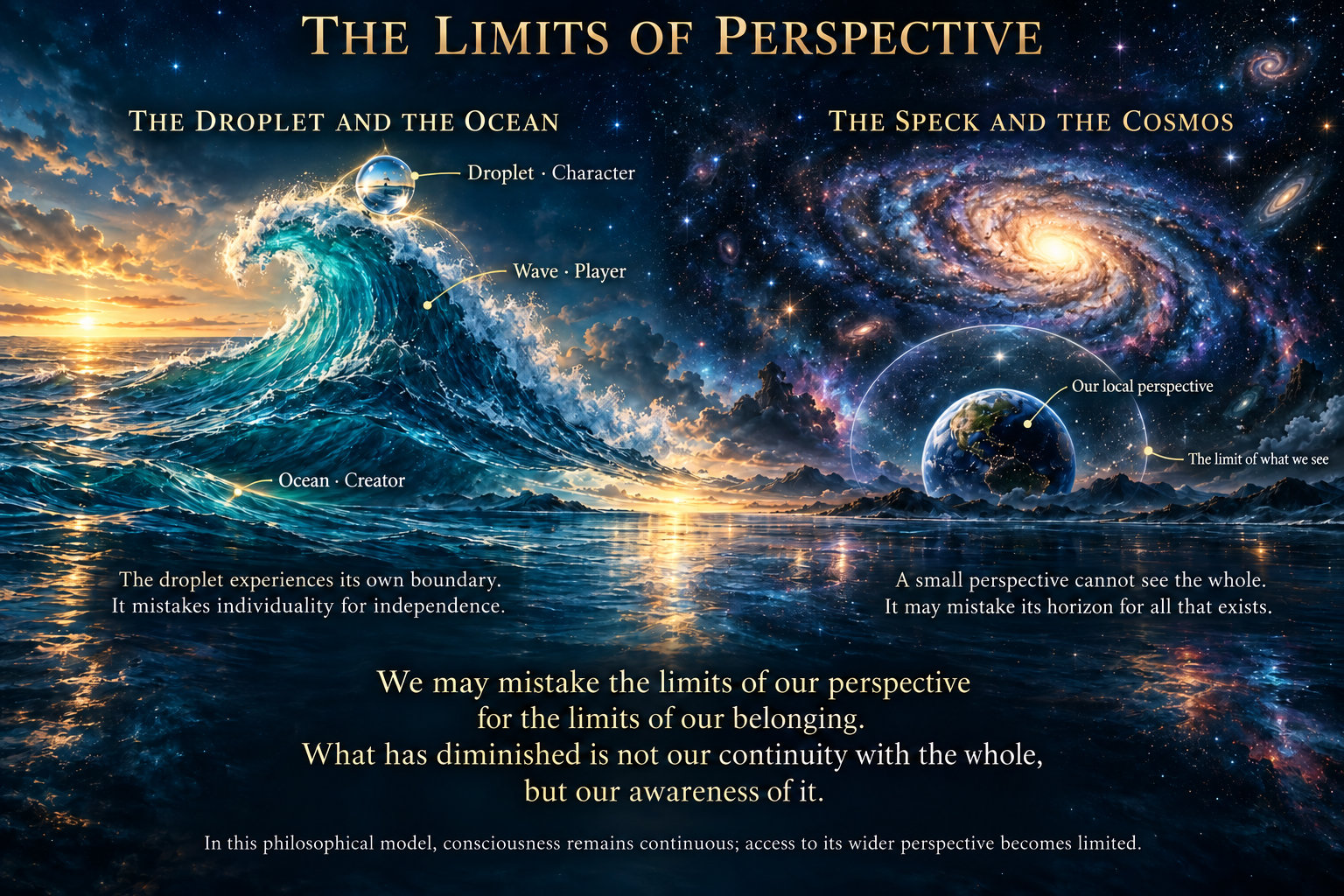
I picture the relationship through three expressions. The character is our everyday self, living within the conditions of a particular life. The player is a wider consciousness. The creator is the source from which both arise. In this model these are expressions of one consciousness rather than three independent beings, and nothing here requires them to be three things.
One note on the middle term, because this work has used another word for it. The player is what The Revolution of the Mind calls the Cosmic Actor, where the actor remains larger than every character and the role is never the whole of the player. It is also what The Central Thesis calls the higher Self, of which we exist as a fractal. Three names, one tier. They are set beside each other here so that a reader meeting all three does not have to guess whether something different is meant.
And a note on the top term, since the companion course is called Living as the Creator and addresses the reader as the creator. That is not a fourth position and not a contradiction. It is the same claim read from the other end. If these are expressions of one consciousness, then the character is not standing below the creator applying for access.
The ocean, the wave and the droplet
The ocean offers a way to picture this. Imagine the creator as the ocean, the player as a wave, and the character as a droplet rising from its crest. The wave is a movement of the ocean. The droplet is a further expression of that movement. Each has a recognizable form, and all three share the nature of water.
The droplet does not have the ocean’s scale or its capacities. A breeze can carry it. A change in temperature can transform it. Its smallness is what makes the conditions immediately around it so influential, which is a fair description of a human life and its weather. Yet it has not become less water by becoming a droplet.
Consciousness may work in a similar way. As its expression becomes more localized, access to its wider perspective becomes limited. The character meets life from within one body and one history, and its immediate circumstances can occupy so much of its awareness that any larger continuity goes out of view. What diminishes, in this account, is access to the whole rather than the nature of what is doing the accessing.
Pillar 7 of The Way already uses the wave, and its lesson is worth carrying here unchanged. Two waves of the same ocean argue about which is wetter. What that pillar denies is not the wave’s existence but its separateness, and the same distinction holds for the droplet. Its individuality is real within its experience. Its complete independence from the whole is the assumption being questioned.
Where the metaphor stops
The metaphor has a limit, and saying so is not a hedge. A physical droplet really can be separated from the ocean. Here it stands for a felt boundary within consciousness, whose underlying continuity is the premise of the inquiry rather than a result of it. An image left without its limit gets read as a mechanism, and this one is not a mechanism.
Inside the image, though, the failure is easy to see. If the droplet could think, it might conclude that its boundary makes it independent. It might notice the wave and take it for something else entirely. It could know exactly where its own form ends and still have no view of the movement that form arose from. Nothing about that conclusion would be careless. It would simply be the only conclusion available from where it was standing.
The horizon is not the edge
The vastness of space gives the same shape a second time. Our lives unfold on a small world inside an immense cosmos. From where we stand, our surroundings can appear all encompassing, our concerns fill our attention, and what happens within one lifetime can feel like the center of existence because it is the center of our experience.
Yet the horizon marks the limit of our view and not the edge of what exists. That distinction is available to anyone and requires no belief at all.
The same distinction may apply to consciousness, and here is where the claim has to stay honest. An inability to perceive a wider connection does not establish its absence. Neither does it prove that such a connection exists. It leaves room for humility: our experience may be genuine without being complete.
That sentence is the standard the rest of this work tries to hold to. Where a claim is about experience it is stated plainly. Where it is about what lies beyond experience it is held open and named as held open, rather than being softened everywhere at once until a reader cannot tell which limits are load bearing.
How the forgetting might happen
Taken together, the two images suggest how forgetting could occur without anything having been done to us. It need not require a barrier that was deliberately imposed. The demands of a localized life may be enough on their own to absorb the character’s attention completely.
From childhood we learn what to fear, what to pursue and who we are expected to become. Those lessons organize experience until the identity they produce feels self evident, and we begin to live as though an acquired description were our entire nature. Almost none of it was chosen. Most of it arrived before there was anybody home to refuse delivery.
Even the search for a higher self can preserve the assumption it was meant to dissolve. We imagine a distant presence that has to be reached, pleased or persuaded into guiding us. Within the image, the player is an extension of the creator and the character is an extension of the player, so the distance belongs to the character’s perspective rather than to the arrangement.
The Pronoun Law describes the same thing from the side of the sentence. What a person holds as true leaves them in the first person and returns to them in the second, which is why the return arrives as though it came from somewhere else. The externality is a change of vantage and not a change of cause. In both descriptions the distance is real as experience and is not a measurement of anything.
What this does not remove
It does not remove responsibility. Whatever their ultimate origin, we meet our decisions through the life we are actually living. We can notice a habit, reconsider an interpretation and choose a more deliberate response, and belonging to something larger changes none of that. If anything it makes the question sharper, because there is nobody else here to answer it.
Nor does recognition require the character to disappear. A wave does not have to lose its form before it can belong to the ocean. We can keep our individuality, honor our relationships and engage fully with work, love and obligation while holding more loosely to the idea that our current identity contains the whole of us.
There is an ebb and flow to this. At times we are absorbed in immediate concerns, and at others the narrow identification loosens on its own. Neither movement is a measure of spiritual worth. The demand to remain permanently awakened is only another identity to defend, and it defends itself as stubbornly as any of the ones it replaced.
Closing
The droplet knows its boundary. The person knows a horizon. Both perspectives can be meaningful without being complete.
We may mistake the limits of our perspective for the limits of our belonging. What has diminished is not our continuity with the whole, but our awareness of it.